

Stop Making Your Life Easier
Your comfort isn't protecting you. It's the thing you need protecting from.

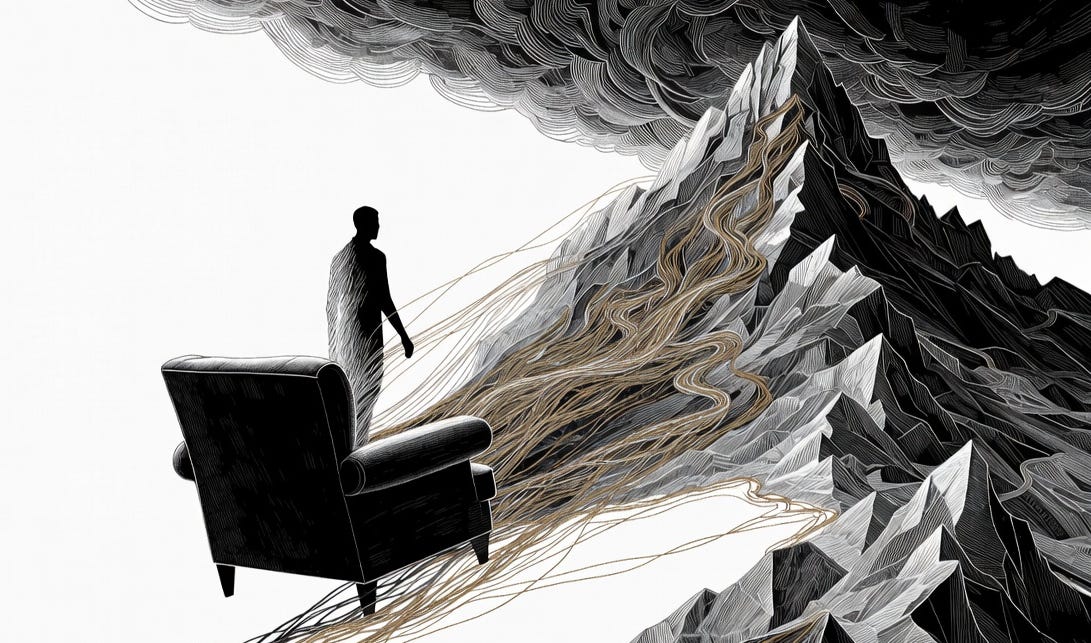
It’s Sunday. Five o’clock. The light outside has turned that particular shade of amber that your nervous system associates with endings, and the dread is here again, right on schedule, like a bill you keep paying for a service you never ordered.
Nothing is wrong, exactly. The fridge is stocked. The weekend delivered on most of its promises. And yet here it is, that formless heaviness settling into your chest. Not sadness. Not anxiety. Something duller than either of those, something without edges, which is precisely why you can’t get a grip on it.
You’ve tried to fix this the way you fix most things: by adding. A new hobby. A better mattress. That trip to Portugal, everyone said, would change your perspective; it didn’t, but the pastéis de nata were excellent, and you came home with a ceramic rooster you have no use for. You’ve tried subtracting, too. The draining friend, the soul-crushing commute, the news habit. Some of it helped. None of it touched whatever lives underneath.
Here’s what I want to propose, and I realize it will sound like the opposite of advice: the ache you keep medicating with comfort is your body requesting discomfort. Specific, chosen discomfort. The kind that costs you something and builds something in return.
The reason this message keeps getting garbled, the reason you hear “I need a vacation” when your body is saying “I need a harder life”, is that you live inside a civilization that has spent seventy years and trillions of dollars perfecting the art of selling you the wrong prescription.
Your Body Keeps Sending Memos You Won’t Read
Viktor Frankl spent three years in a Nazi concentration camp. He lost his wife, his parents, his brother, and every external marker of the identity he’d spent a career constructing. From inside that machinery, while starving, while being systematically dehumanized, not from the safe distance of retrospect, he noticed something the architects of the camp hadn’t planned for. The prisoners who survived weren’t the strongest or the youngest. They were the ones who had a reason to survive. A manuscript to finish. A child to find. A purpose that stretched past the barbed wire.
His formulation was as clean as a blade: those who have a why can endure almost any how.
That line has been printed on enough motivational posters to sand off its teeth. Which is a tragedy, because Frankl wasn’t talking about motivation. He was describing biology. Meaning, he argued, is not a luxury you pursue once the basics are taken care of. It is itself a basic, as fundamental as food. Remove it, and the organism doesn’t crash. It withdraws. Quietly. The way a plant pulls its energy back from its outermost leaves long before anyone notices it’s dying.
That slow withdrawal of vitality you keep catching at 5 p.m. on Sundays? That’s not a mood. That’s a memo. Your body has been sending it for years, and you keep filing it under “vague dissatisfaction” and prescribing another streaming service.
The Lie That Comfort Sold You
Here’s where it gets uncomfortable. Which, given the thesis of this article, might be exactly the point.
The entire machinery of consumer culture runs on one premise: removing difficulty equals arriving at happiness. Every ad, every convenience app, every optimized friction point between you and ease is built on this equation. The equation is wrong. Not slightly mis-calibrated, wrong the way a map flipped upside down is wrong. All the right landmarks, completely useless for navigation.
I want to be clear: comfort is wonderful. I’m not here to tell you to sell your furniture and sleep on nails. Comfort is the baseline from which a life can begin to do something interesting. But somewhere along the way, the baseline became the goal. The preparation became the destination. And we ended up engineering entire lives around achieving a state of total ease that was only ever meant to be the starting position.
Mihaly Csikszentmihalyi spent decades studying what people were doing during the moments they later described as the best of their lives. The finding is almost comically counterintuitive: the peak moments were not vacations. They weren’t celebrations or beaches or good news arriving by phone. They were moments of total engagement with a challenge matched to the person’s ability, right at the edge of what they could handle, where effort and skill meet, and the self temporarily vanishes into the doing.
He called it flow. I’d call it the opposite of your Sunday evening.
I Know Because I Left the Comfortable Chair
I can talk about this with some authority because I’ve been on both sides of it. Years ago, I had a perfectly good life in Ottawa, the city I grew up in, a stable job, a clear enough trajectory. I was comfortable in the way a person can be, yet still feel like they’re slowly disappearing. The work wasn’t bad. The paycheques cleared. And every Sunday evening, that same dull fog rolled in, and I couldn’t explain it to anyone because from the outside, nothing was wrong.
So, I quit. All of it. Moved to British Columbia knowing nobody, with no plan beyond the conviction that the fog was telling me something and the something was not “stay here.”
What happened next wasn’t a montage. It was messy and frightening and involved more ramen noodles than I care to remember. But I fell in with people in the wine industry, said yes to things I had no business saying yes to, and that recklessness, that willingness to be uncomfortable on purpose, carried me to places I couldn’t have designed on a whiteboard. I eventually moved to Asia with my wife and my three daughters in tow. I lived in China. Thailand. Worked in India, Spain, Italy, Chile and all over the US.
I learned to make wine, then cider, then business building. At one point, I pitched a business idea in Thailand for over a year with no revenue, to the point of not being able to pay next month’s rent or afford to leave the country in shame, until I finally found an investor who decided to fund my project. Each time I was out of my depth, and each time the discomfort built something the comfort never had.
Today I run my own companies. I pick the projects that challenge me and politely ignore the ones that don’t. Experienced incredible things that would have never happened and would have just dreamed about if I had stayed in Ottawa.
None of it came from a plan. It came from walking through a door I was afraid to walk through and discovering that the fear and the meaning were standing in the same spot.
That idea, that the fear and the meaning occupy the same address, became the spine of a book I've been writing called The Twelve Truths. It's twelve chapters, each one built around a truth I wish someone had told me before I needed to learn it the expensive way. This article is the third. The other eleven hit just as hard.
The Question You Were Never Taught to Ask
Most of us got handed the same question early on and never thought to trade it in: How do I find happiness? How do I reach the point where the struggle stops and the reward begins?
That question has no useful answer. It’s built on a false foundation, that suffering is a bug you can patch out of the system. You can’t. Suffering is structural, woven into conscious experience like gravity into physical space. You will suffer. The only variable is which kind.
The suffering of discipline, or the suffering of regret. The suffering of creative risk, or the suffering of arriving at sixty-five, having never found out what you could make. These aren’t equivalent. One kind builds something. The other just accumulates, like silt in a river nobody’s bothering to dredge.
The person who trains for a marathon suffers. The person who avoids anything physically demanding for a decade also suffers, in their body, in the slow shrinking of what they believe they’re capable of. The difference isn’t the presence of pain. It’s that one form of pain has a direction. It’s pointed at something. It’s constructing something. The other just sits there, formless, settling into Sunday evenings.
The Evening Is Still Here
So, Monday is still coming. The dread hasn’t been argued away by anything you just read, because the dread isn’t an argument. It’s a sensation, and sensations don’t yield to essays.
But maybe the question shifts. Not how do I escape this, but what would I be willing to struggle for? What difficulty would I actually choose if I stopped being so careful about choosing?
You don’t have to answer tonight. Let the question sit where the dread usually parks itself. It weighs about the same.
If this is the kind of thing that rattles around in your head at odd hours, The Twelve Truths was written for exactly that version of you. Eleven more chapters. Eleven more doors you've been pretending aren't there.
Like what you read? Please support my work with a coffee. Thank you! This means more to me than you know. Also, check out my other writings HERE.
Well written wisdom concept!
Embrace the suck.